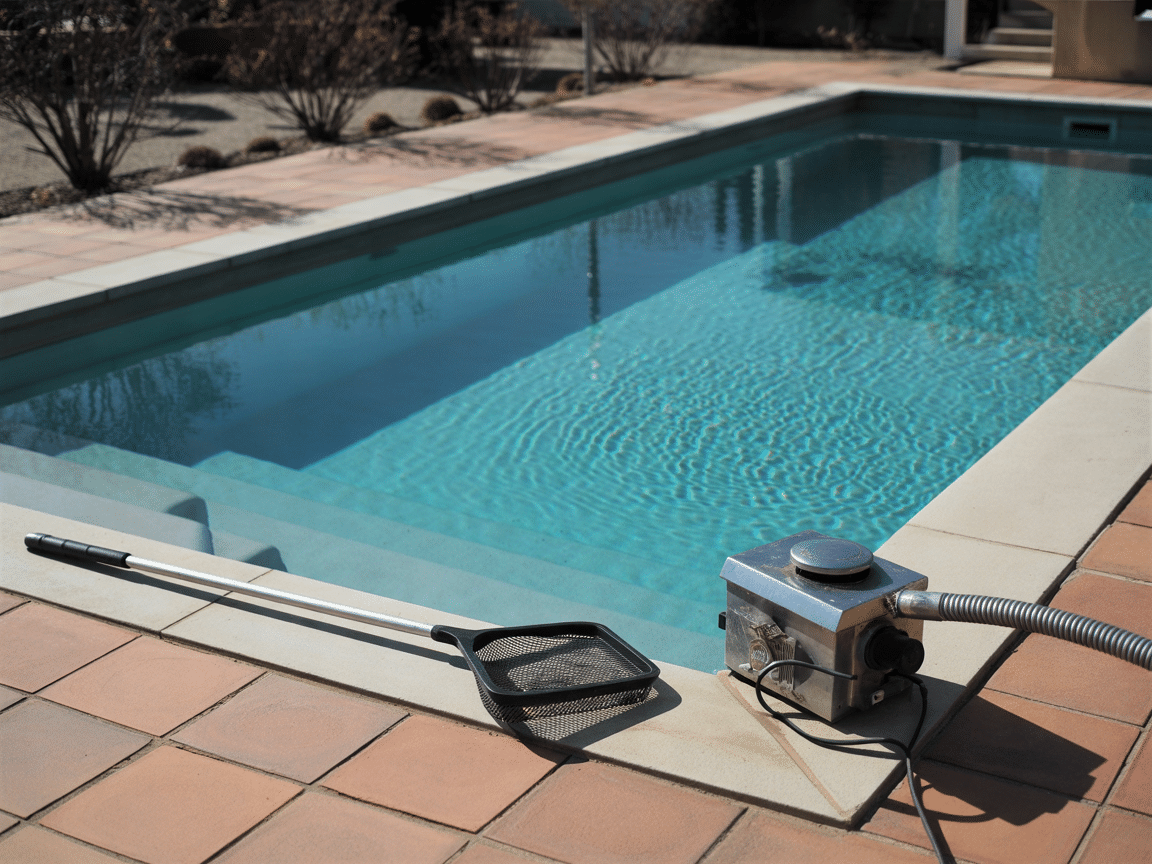
San Diego’s mild winter climate means pool owners don’t face the freezing temperatures common in other regions. According to the National Weather Service (2024), San Diego winter lows rarely drop below 45°F (7°C), so full winterization isn’t necessary. Instead, winter pool care focuses on adjusting your maintenance routine to match reduced sunlight, cooler water, and less frequent swimming. This guide breaks the process into seven concrete steps, each designed to take only a few minutes per week, so your pool stays swim-ready even if you use it less often between December and February.
Before You Begin: Prerequisites
Gather these items before starting your winter maintenance routine. Having everything on hand reduces weekly maintenance time and prevents mid-task trips to the pool store.
Pool testing kit or test strips for pH, alkalinity, and chlorine (liquid test kits are more accurate than strips for pH readings)
Pool chemicals: chlorine or saltwater sanitizer, pH increaser/decreaser, alkalinity increaser, algaecide, and a chlorine-based shock treatment
Pool cover (solar or thermal) sized for your pool shape, plus a cover reel if your pool is larger than 400 square feet
Basic tools: pool skimmer net, pool vacuum (manual or robotic), filter cleaning supplies, and a stiff pool brush
Knowledge check: Know whether you have a saltwater pool or a traditional chlorine system, since maintenance steps differ slightly; saltwater systems rely on a chlorinator cell rather than manual chlorine dosing
Step 1: Adjust Your Pool Pump Timer for Winter
Reduce your pump schedule, because cooler water needs less circulation to stay sanitized. Water below 65°F slows bacterial and algae growth, so your filtration system doesn’t need to run as long to keep the pool clear.
Set your pool pump timer to run 4-6 hours daily, down from 8-10 hours in summer.
Run the pump during midday hours (11 AM-3 PM) when temperatures peak, since this window also maximizes heating efficiency if you have solar panels.
Use an energy-efficient variable-speed pump and set it to a lower RPM for winter to cut energy costs.
Split the runtime into two shorter cycles (for example, two hours in the morning and two to four hours midday) if your pool collects heavy debris from nearby trees.
This adjusted schedule keeps water circulating adequately without wasting electricity. A variable-speed pump set to a lower winter RPM can use roughly 70% less energy than a single-speed pump running on a traditional summer schedule, according to the U.S. Department of Energy (2023).
Step 2: Test and Balance Pool Water Weekly
Consistent water testing prevents algae growth and equipment damage. Cooler temperatures slow chemical reactions, so imbalances that would show up quickly in summer can go unnoticed for weeks in winter if you skip testing.
Target Pool Chemical Balance Ranges
Parameter
Ideal Range
pH levels
7.4-7.6
Alkalinity
80-120 ppm
Chlorine (sanitizer)
1-3 ppm
Salt (saltwater pool)
2,700-3,400 ppm
Test pH and alkalinity once weekly using a liquid test kit; test twice weekly if the pool receives heavy winter rain runoff.
Add chlorine as needed to maintain sanitizer levels. For saltwater pools, lower the chlorinator’s output percentage for winter, and note that many salt cells stop producing chlorine when water drops below about 60°F, so you may need to supplement with liquid chlorine.
Adjust alkalinity before pH, since alkalinity stabilizes pH long-term and prevents the “pH bounce” common after winter rainstorms.
Record each week’s readings in a simple log (paper or app) so you can spot trends, such as a slow alkalinity drift, before they become problems.
Step 3: Clean the Pool Filter and Skimmer
Falling leaves and seasonal debris increase during California’s winter months, even without snow. Santa Ana wind events, common in San Diego from October through January, can blow in unusually large amounts of leaves and dust overnight.
Empty the skimmer basket twice weekly to prevent clogs, increasing to every other day during and after windstorms.
Backwash (sand or DE) or rinse (cartridge) your filter when the pressure gauge reads 8-10 psi above its clean baseline, which typically works out to every 2-4 weeks in winter.
Run the pool vacuum every 1-2 weeks to remove settled debris from the pool floor, prioritizing corners and steps where leaves accumulate.
Rinse cartridge filters with a hose nozzle rather than a pressure washer to avoid tearing the pleats, which shortens filter lifespan.
Regular filter cleaning supports your pool’s overall filtration system and prevents strain on the pump. A clogged filter forces the pump to work harder, which can raise energy use and shorten motor life.
Step 4: Manage Pool Heater and Heating Costs
Heating a pool becomes more expensive in winter without proper planning. Gas heaters and electric heat pumps both lose efficiency as air temperature drops, so small adjustments make a measurable difference in monthly bills.
Lower your heater’s target temperature to 78-80°F if you still plan to swim; each additional degree can add 10-30% to heating costs depending on heater type.
Switch to a solar pool heater when possible, since San Diego averages 266 sunny days per year (NOAA, 2023), making solar one of the most cost-effective heating options locally.
Pair your heater with a pool cover to trap heat and reduce evaporation by up to 95% (California Energy Commission, 2022).
Run the heater only during pump operation hours, and schedule swims around the midday heating window to avoid heating overnight when heat loss is greatest.
For homeowners who want professional help, a local provider offering winter pool maintenance San Diego homeowners can rely on can optimize heater settings and reduce heating costs for your specific equipment.
Should You Cover Your Pool in San Diego Winter?
Yes. Covering your pool reduces evaporation, blocks debris, and retains heat, even in a mild climate. Benefits include lower chemical use, reduced water loss, and fewer algae problems. A solar cover can raise water temperature by 4-8°F while also cutting evaporation, while an opaque thermal cover blocks more sunlight and is better suited to pools already prone to algae.
Step 5: Prevent Algae Growth
Algae prevention requires proactive chemical balance, not just reactive treatment. Even though cooler water slows algae growth compared to summer, reduced pump runtime and inconsistent testing create openings for outbreaks.
Shock your pool with a chlorine-based shock every 2-4 weeks, even in winter, and always at dusk so sunlight doesn’t burn off the chlorine before it works.
Brush pool walls and steps weekly to disrupt early algae formation, paying extra attention to shaded areas and steps where circulation is weakest.
Maintain consistent chlorine levels, since inconsistent sanitizer levels are one of the most common causes of winter algae blooms.
Add algaecide after shocking if your pool has a history of recurring algae, following label dosing based on pool volume in gallons.
Unlike summer algae outbreaks driven by heat, winter algae in San Diego usually results from reduced circulation and inconsistent testing rather than water temperature itself.
Step 6: Maintain Pool Equipment and Pool Deck
Protecting your pool equipment extends its lifespan and avoids costly repairs. Coastal moisture and salt air accelerate wear on metal components, even when a pool sits unused for part of the week.
Inspect pool surfaces (plaster, tile, or vinyl liner) monthly for cracks, chips, or tears, and repair small damage promptly before it spreads.
Check pump and heater connections for corrosion, especially in coastal San Diego areas with salt air exposure; a light coating of corrosion-inhibiting spray on metal fittings can help.
Clean the pool deck monthly to prevent algae and mildew buildup from morning dew, using a stiff broom and a diluted bleach solution on stubborn spots (rinse away from the pool to avoid affecting water chemistry).
Inspect visible wiring and GFCI outlets near the equipment pad after heavy winter rains to confirm there’s no water intrusion.
Step 7: Decide If You Need a Pool Cleaning Service
If winter pool care feels too time-consuming, a pool cleaning service or pool maintenance company can manage weekly tasks.
Professional residential pool service typically costs $80-150 per month in San Diego (2024 market average), with saltwater and heated pools trending toward the higher end.
Services include chemical testing, filter cleaning, and equipment maintenance, and many companies also handle seasonal cover installation and removal.
This option suits owners with saltwater pools or complex heating systems that require specialized knowledge, as well as homeowners who travel frequently during winter.
Troubleshooting Common Winter Pool Issues
If your pool water turns green → Test pH and chlorine immediately, then shock the pool and brush all surfaces within 24 hours; retest the next day to confirm chlorine has held above 1 ppm.
If water levels drop quickly → Check for leaks first; if none exist, it’s normal evaporation. Top off weekly with a garden hose to keep the water level at the middle of the skimmer opening.
If your pool heater won’t reach temperature → Verify the pool cover is in place and confirm the thermostat setting hasn’t reset after a power outage; if the problem continues, have a technician check for pilot light or electrical issues.
If algae returns repeatedly → Increase sanitizer dosage, add 1-2 hours of daily pump runtime to improve circulation, and consider rotating to a different algaecide formula.
If your saltwater pool shows low salt readings → Add pool-grade salt gradually and retest after 24 hours of circulation, since adding too much at once can cause uneven distribution and inaccurate readings.
Should I Drain My Pool for Winter in San Diego?
No, draining is not recommended. San Diego’s mild winter allows year-round pool operation without risk of freeze damage, so draining is unnecessary. An empty pool can suffer serious damage: vinyl liners can shrink or tear, and plaster or gunite shells can crack or even lift from hydrostatic groundwater pressure, particularly after winter rains saturate the soil.
Next Steps: Preparing for Spring
As temperatures rise in March, transition back to your full pool care routine.
Gradually increase pump timer settings back to 8-10 hours daily over two to three weeks rather than all at once.
Deep clean the filter before peak swimming season begins, replacing cartridge filters or DE grids that show wear.
Retest and rebalance all pool chemicals, since spring algae blooms often follow winter once water temperatures climb above 65°F.
Remove and store your thermal cover if you won’t need it for spring, inspecting it for wear and patching small tears to extend its usable life.
Following this seasonal checklist keeps backyard pool upkeep manageable, even during California’s cooler months. Consistent skimming, balanced water chemistry, and smart pump scheduling are the foundation of year-round pool maintenance in San Diego.